The Hive Journey
# 1. Lessons of Innovation Inside a 100-Year-Old Corporate
Hive was never meant to happen. It was a mix of luck, vision, gutsy leadership, and a case of the right people being in the right place at the right time.
British Gas, a 100-year-old energy giant, quickly realised they had neither the people nor the processes to build consumer tech products. Why would they? In 2010, most companies didn’t offer supporting apps that we’re so used to today.
The arrival of IoT and Smart Home tech in 2011 presented British Gas with an opportunity that was too good to pass up. It’s worth noting that the British Gas Technology team, led by David Cooper alongside Daljit Rehal, Phil Crannage, and Ash Jokhoo, had delivered several successful tech initiatives in the years prior, paving the way for Hive.
Hive went on to become the UK’s largest smart home provider, with many notable accomplishments related to the product, customer experience, support, and marketing. But the lessons were hard-won. Here’s a glimpse into some of the thinking behind Hive and our experience, which I hope helps others trying to do something similar.
Before we begin, let me clarify one important point. There’s no universal “right” or “wrong” way to do things; context is everything. What works for a large company in one industry won’t necessarily suit a startup in another.
# 2. The Context for Hive: Why We Did Things Differently
Hive wasn’t British Gas’s first attempt at smart home tech. They had already created “Connected Homes,” a well-intentioned department that didn’t quite deliver. Not because the people weren’t smart—they were. But the setup was wrong.
Phil Bentley, British Gas’s CEO at the time, saw this. He knew British Gas wasn’t equipped to build a consumer tech company from within. But he also understood that complete separation wouldn’t work. Too much distance leads to “ivory tower” innovation and its associated risks.
That’s where Nina Bhatia and Andrew Brem came in. They found the right balance between autonomy and integration—a challenge most big companies at the time didn’t get right.
# 3. The Ten Principles
In 2012, I got a call from David Cooper, who was the CTO of British Gas at the time. He wanted me to take a look at their Smart Home initiative. David introduced me to Dean Keeling, who was leading the effort. Dean was refreshingly candid, laying out the challenges clearly. He had a sharp sense of what he wanted from both the business and the product. So I got started.
Six weeks later, as I was wrapping up my work, I sent an email to David and Dean with my final report containing my findings. I figured that was the end of my involvement. But then something unexpected happened. That email somehow made its way to Phil Bentley (the Managing Director), Ian Peters, and Nina Bhatia—senior leaders at British Gas. What followed was a bit of a blur, and to this day, I’m not entirely sure how things unfolded behind the scenes. All I know is that email set off a chain of events.
At the time, I had already accepted a job in the Middle East. My family and I were preparing to move in just a few weeks. Beyond that, I wasn’t particularly optimistic about British Gas’s chances of succeeding in the consumer Smart Home market. From experience, I knew that large companies trying to break into new or adjacent markets had a very high failure rate unless certain conditions were met—and British Gas wasn’t even close to meeting those conditions.
So when Nina reached out and offered me a role at British Gas, I politely declined. I didn’t think it was a good fit and shared my thoughts. That’s when she asked me two questions:
First: What would it take for British Gas to succeed in this market? And second: What would it take for us to hire someone like you?
The first question was easy to answer—I’d been thinking about it for years. The answer to the second question depended on the first. The right people will only join if you have the right conditions. In my mind, there were ten essential things a large company needed to do to successfully build a business in a new or adjacent market. So I shared my list.
What happened next caught me off guard. Phil and Nina not only listened but agreed to implement nine things on the list. To say I was stunned is an understatement. Large companies aren’t exactly known for their willingness to change course—but to do it in a matter of days was unheard of. But they were serious. And that’s how it started.
These ten points became our blueprint at Hive:
-
Run Hive like a lean startup: Experimentation, customer testing, and fast iteration became our mantra (Eric Ries eat your heart out!).
-
Colocate the team: Everyone worked together in one building in central London—no time-slicing or remote teams. 100% focus on Hive.
-
Separate business unit: Hive was carved out as its own entity, with control over its own brand and budget. This included freedom from corporate IT systems and controls—a seemingly trivial point that turned out to be critical for moving quickly and attracting top developers who preferred Linux-based open-source technologies.
-
Freedom to conduct market/product/customer research: It was crucial for Hive to work directly with customers and carry out its own research. Creating a new product requires rapid iteration—a process that falls apart if you rely on an overstretched central team.
-
In-house technology team: Initially focused on front-end technologies, we later acquired and integrated AlertMe—the startup that built our core platform—which was key for agility and creating a new category of tech products.
-
In-house product management team: A vital function for a product-led business—something many big companies at the time didn’t fully understand.
-
Agreed budget/funding upfront: It was important to know what we could and couldn’t afford while avoiding an onerous approvals process for every penny.
-
Dotted reporting lines to BG’s CTO: To avoid “ivory tower” innovation while integrating with the core business, Hive’s CTO had a dotted reporting line to British Gas’s CTO (initially me; later Seb Chakraborty).
-
Hiring freedom and no reliance on “shared” services from the core business: We could hire externally without relying on teams whose primary responsibility was British Gas rather than Hive.
-
Direct governance: Instead of reporting through layers of management, we had a direct line to the British Gas board.
These principles weren’t just about speed; they are the necessary conditions for succeeding. The odds are already stacked against creating a new business or product. Layer on corporate internal inertia at every step and you’ve obliterated any chance of winning, regardless how good your idea is. A reminder of the context. We were trying to create a new product in a new category of products, in a company that didn’t have, and actually didn’t need until now, the experience or capability to do this. This is about recognising the right rules for the game and knowing what you don’t know.
# 4. Something Old, Something New & A Purpose
Half of Hive’s team came from British Gas; the other half were external hires. This mix turned out to be crucial, and admittedly, it wasn’t something that was deliberate. The external hires brought the Product Management and Technology experience in open source technologies, public cloud platforms, and fast-moving consumer tech markets. The internal hires brought deep knowledge of British Gas’s customers and systems and it was this blend of people that played in a big part in our success. Many of the British Gas people had no experience in Customer/Product Management, Agile Development.
We hired some of the best people we could find, but here’s the interesting part. Within a few months the people who’d joined Hive from British Gas were performing just as well the external hires. It just goes to show the impact of creating the right environment.
We created a culture of collaboration across disciplines — bringing Marketing, Product, Technology, and Customer Support together in one flat organisation where everyone was focused on outcomes for the customer. No dept silos. Having the team physically in one place made it a lot easier. I know that’s not a popular concept today, and I am not passing judgements on working from home. My point is that for our specific set of circumstances it made things easier.
Hive was place where you were judged on the value of your input not your job title and there no general managers. Everyone was hands-on. Culture wasn’t a “nice-to-have”, it was a necessary condition for collaboration to deliver the right outcomes.
Daniel Pink’s book “Drive: The Surprising Truth About What Motivates Us” explains the importance of having a shared purpose better than I can.
The most deeply motivated people—not to mention those who are most productive and satisfied—hitch their desires to a cause larger than themselves.
People are more motivated when they feel what they do day-to-day contributes to a cause greater than their own personal success. We continually emphasised Hive’s purpose and how each team was contributing to that purpose. Being in the same office made it easier to continually reinforce this purpose. And wow. I’d never seen such a motivated and collaborative team. There was (to quote Andrew Brem) a “restlessness” and desire “to do your best work, ever”.
# 5. Focus: Doing Fewer Things
Anyone who joined Hive from British Gas had to focus 100% on Hive. So for example, you couldn’t work on a British Gas project while working on Hive. Corporates often put their best people on multiple projects at the same time. This dilutes their effort, resulting in worse outcomes. Focus on a few things, and do them well.
# 6. A Product Mindset: Outcomes Over Outputs
One of the biggest shifts was adopting a Product Management mindset. Corporates often measure success by outputs: Did we launch the feature? Did we hit the deadline? Of course these things remained important, but it was secondary to achieving outcomes: Did this feature solve a real customer problem? Are people using it? Is it easy and intuitive to use? If there’s a single thing you take from this note, then let it be this; A product’s true success isn’t in its launch or how many features it has — it’s in the real world problems it solves, the lives it improves, and the way people embrace it.
When you first develop a product, it rarely hits the mark. It requires constant testing and iteration. We embraced many of Eric Ries’s Lean Startup principles for this very reason. However, there was enough experience in the team to appreciate these were guiding principles and one way of doing things rather than dogmatic set of instructions:
- Everything is a hypothesis and needs validation with real data.
- Test ideas with customers before committing significant resources – Use customer interviews, prototypes, usage data and trials to uncover real needs instead of relying on assumptions.
- Real usage data that is the only way to understand how customers interacted with our products.
- Iterate quickly based on feedback—build something small, test it, learn, improve, and repeat.
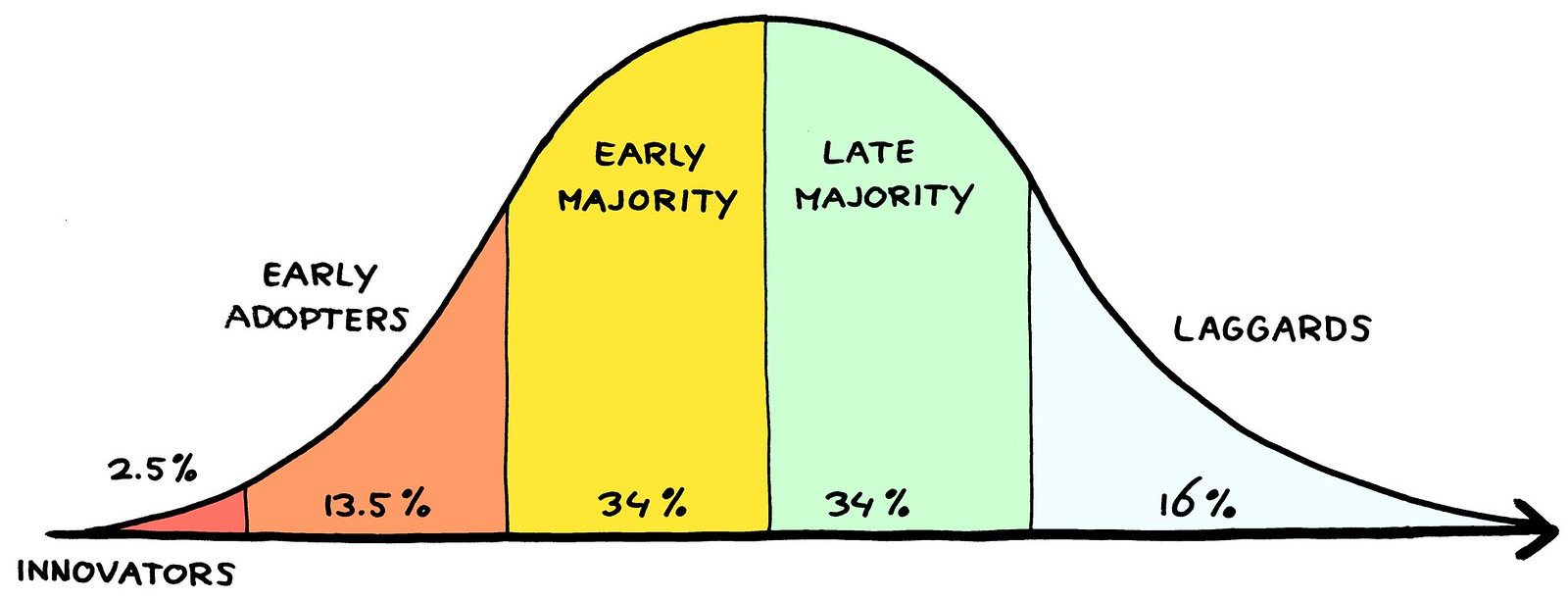
The Hive thermostat didn’t aim to go head-to-head with Nest’s product, which was targeted at the typical “Early Adopters.” Instead, we focused on simplicity and familiarity. Our apps were easy to use and intuitive, but most importantly, they felt like a seamless extension of what people were already accustomed to. The physical thermostat itself was designed with a retro aesthetic, appealing to older and less tech-savvy users. The outcome? Hive was quickly embraced by the group we refer to as the “Early Majority”—much faster than anything I’d seen in my career.
(credits: Jurgen Appelo)
# 7. Leading (& Bleeding) Edge Technology
Hive’s technology was built in-house, using open-source tools that were, for the time, cutting-edge. It wasn’t just a choice—it was the right choice for where we were. Open source gave us the control, speed, and unique edge we needed. Here’s why.
Cost-Effective: Open source saved us from paying hefty licensing fees. Sure, building and running your own tech isn’t cheap compared to buying off-the-shelf solutions. But when you’re in discovery mode—experimenting, iterating—nothing beats it. There’s simply no cheaper way to move fast and learn.
Competitive Edge: In 2012, off-the-shelf solutions didn’t cut it. If you wanted something that worked exactly the way you needed, you had to build it yourself. For us, this wasn’t just a challenge—it was an advantage. It kept competitors out because the barrier to entry was high.
Flexibility: With open source, we weren’t tied to someone else’s roadmap. We could make changes whenever we needed to, without waiting for a third-party vendor to prioritise, if they ever did, what mattered to us. No compromises. Just progress.
Agility: Having the tech team in-house meant we could move fast. Really fast. The developers worked right next to Product, Marketing, and Support. If a feature needed tweaking or a problem cropped up, you didn’t schedule a call or log a ticket—you just walked over and spoke to the person who could fix it.
Collaboration: Our developers weren’t just “resources”—they were part of the team, fully invested in what we were building. They saw firsthand how their work helped customers and understood what we were trying to achieve. That kind of alignment isn’t something you can outsource. And it showed in the quality and impact of what we built.
Fast forward to today, and things are different. Platform-as-a-Service (PaaS) cloud tools and modern software frameworks have made it easier, and cheaper, to do things:
-
Scalable systems: RESTful architectures and containerisation tools like Kubernetes and Docker make scaling seamless.
-
Real-time processing: Tools like RabbitMQ and Kafka handle millions of events effortlessly.
-
Big data: NoSQL databases like Cassandra and MongoDB make storing and processing massive datasets straightforward.
-
Beautiful apps: Frameworks now make it easy to build web and mobile apps that look great and feel intuitive.
In 2025 these are nicely packaged and ready to go. But in 2012? Back then, you had to “roll your own”. Was it painful? O, yes. Leading edge sometimes felt “bleeding edge”. Was it worth it? No question.
# 8. What Didn’t Work
It’d be disingenuous to suggest Hive was Nirvana. Of course we made lots of mistakes along the way. Often the most valuable lessons come from our failures and we should take what we can from the pain.
Here’s a few of the things that didn’t work:
- Monetisation Challenges: While customers loved our products (we had industry-leading NPS scores), we struggled with getting customers over the line from a one-off price to subscription. The costs of running connected services—cloud infrastructure, customer support, and ongoing product updates—were significant, but sadly there weren’t enough customers willing to pay subscription fees. This raised tough questions about long-term sustainability, not just for Hive, but the whole consumer smart home category.
- Bundling British Gas Services with Hive Products Was Harder Than We expected: These integrations were far more time-consuming than we expected.
- Recognising When to Stop: Like many organisations, we sometimes let underperforming projects limp along for too long instead of cutting our losses early.
# 9. Final Thoughts
Creating Hive wasn’t easy, but it worked because we built a team and culture that could adapt and learn quickly. We didn’t have all the answers upfront — and we made plenty of mistakes — but by staying focused on customers outcomes and cultivating an environment where data informed decisions, we were able to build something that genuinely made people’s lives easier.
Finally, if anyone tells you there’s a magic formula or way of doing things guaranteeing success, pause, smile and find someone else to talk to. All you can do is reduce risks of failure. Get the right mix of skills and experience, build the right culture, and people will do amazing things. I know, because I had the privilege and honour of working with the amazing people of Team Hive.
# 10. Who’s Who?
I know I’ve missed some names out, and for the record, the names are in random order.
Nina Bhatia, Andrew Brem, Colin Guard, Pamela Brown, Tom Guy, Seb Chakraborty, Simon Baker, Stephane Blanc, Neil Proctor, Julian Browne, Kim Ratcliffe, Adi Heesom, Keith Gough, Jim Anning, Bronwyn King, Suzanne Johnson Smith, Fiona Howarth, Ben Carter, Mark Smith, Paul Grosvenor, Ashley Smith, Lara Daniell, Graham Hepburn, Grant Smith, Charlotte Bateman, Helen Haynes, Andreu Tobella Brunet, Jorja Darwin, Rebecca Dibb-Simkin, Christophe Popov, Shaw Stapley, Louise Yarrall, Darcy Rossiter, Marina Tita, Mario Rauter, Ewa Lascelles, Johanna Hunt, Betsy Bassis, Ceri-Ann Sandford, Mark Lowther, Anna Gustavasson, Aimee Clark, Nigel Pugh, Gilles Corby, Gemma Maybury, Charlotte Crook, Leslie Owensby, Candace Morris, Kerry McKerron, Elvin Nagamootoo, Dharminder Sangha, Chris Laucht, Gemma Brady, Gawain Edwards, Ian Hutton, Johan Haynes, Michael Anaman, Uday Pandey, Nora Langi, Zoe Dyer, Tarek Boudour, Nicola Battey, Craig Chandler, John Gutch, Adrian Evans, Hakon Martinsen, Chris Beanland, Sam Barton, Jay Harrison, Lucy Campbell-Gilling, Dom Elis, Boyan Siderov, Nicolas Mouazan, Stephen Werner, Karolina Ayan, Just Heaver, Ryan Harris, Gideon Summerfield, Jamie Logue, Darren Houghton, Alex Kiernan, Giles Howland, Jess Kyte, Sam Lowe, Peter Bevan, Hollie Herffernam, Khuram Pervez, Jonathan Wright
Notes mentioning this note
There are no notes linking to this note.