Operational Excellence
# 1. Introduction
2023 and 2024 haven’t been good years for private equity or VCs. While 2024 was better than 2023, 2023 was one of the worst years on record. Higher interest rates, inflation, and global conflicts have all converged to slow investment, with funds holding onto assets much longer, as the graph below shows.
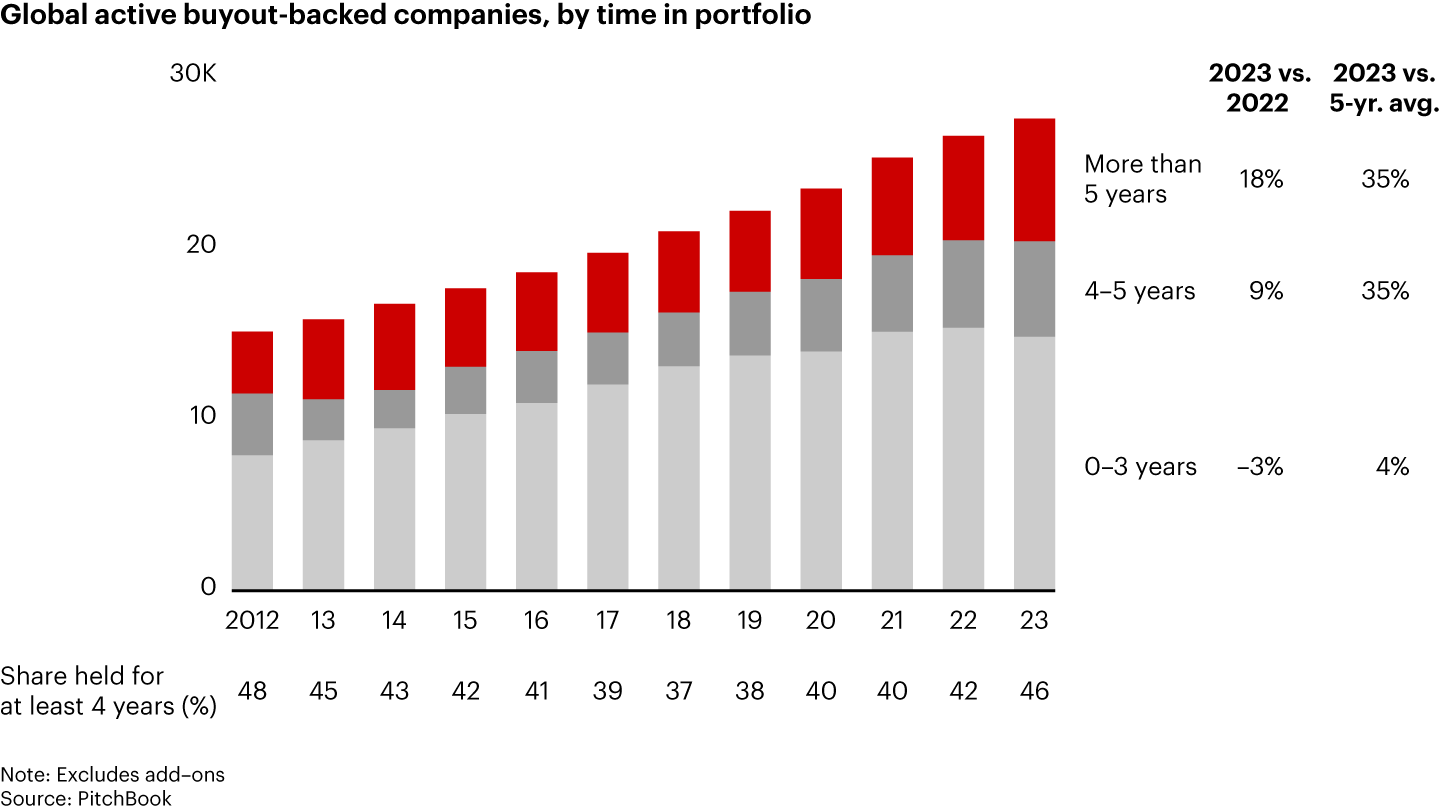
SOURCE 1
Funds derive returns from three sources:
- Returns through deleveraging
- Profits from an exit
- Increased earnings from portfolio companies.
Higher interest rates have made deleveraging harder, and since there are fewer exits, there is less profit from sales. This puts more pressure on increasing earnings from portfolio companies for returns. Increasing earnings is achieved by increasing revenue, profit, or both.
A CTO has an important role in delivering efficiency and reducing cost, particularly where a company relies heavily on tech for products and services or back-office functions. While this sounds negative, it doesn’t have to be if this means deploying a technology sooner than you might have otherwise done, which will help future growth.
AI and LLMs can help do more for less, but they’re not the only options. There might be cheaper and less risky alternatives that we’ll explore in this note.
# 2. AI/LLM Solutions
It would be amiss of me not to mention AI/LLM and the impact they can have on efficiencies, but they’re not the only answer. There are more mature and less risky technology options we’ll discuss later on.
It’s important to make a distinction between building a product using an LLM yourself versus buying an off-the-shelf product that incorporates an LLM. In the latter case, someone has done all the hard work designing, tuning, and optimizing the LLM into the product you’re buying. Building your own application on top of an LLM is not for the faint-hearted as it requires significant technical expertise, a lot of effort, and there is no guarantee you’ll get what you need. Early adopters of LLMs have had no choice but to go down this route. There’s been more than $15bn of LLM investment in 2023 and 2024, but very few deployments into production solutions yet.
The good news is we’re starting to hear more about domain-specific LLM-based products rather than the LLMs themselves. This trend will continue, and we’ll hear less about LLMs in 2025 and more about the applications built on top of LLMs, which will lower barriers to entry and drive greater adoption. There’s time.
Building or buying an LLM application isn’t the only option to become more efficient. There are many more mature technologies available right now that are cheaper and less risky than LLMs. I would focus on basic automation first, and if that product happens to use LLMs, great—but the primary focus should be automating the easy stuff using traditional technologies.
The key message is that there’s plenty of time to jump on the LLM bandwagon; focus on basic automation first.
# 3. Efficiency Options
Workflow and process automation technologies aren’t new, but they can yield lots of small improvements; the “aggregation of marginal gains”2 from automating lots of small things can deliver as much benefit as one big innovative LLM-based project, but without all the risks.
Let’s take a closer look at opportunities in technology and the broader business.
# 3.1. Technology Team Efficiencies
Assuming you have a significant amount of in-house technology, the obvious automation candidates are:
-
Implement CI/CD pipelines for your environments so you can not only deploy more frequently but also save time without compromising quality. If you’ve already got a pipeline, have you implemented:
- Continuous Deployment into production and not just Continuous Delivery?
- Comprehensive test automation – A good benchmark for automated vs manual testing is 70% and 30%, respectively. A robust test framework reduces the number and frequency of bugs.
-
Leveraging Cloud Scaling – Provisioning infrastructure in the cloud is easier than in your own data center, but you need to be in the cloud first. If everything is hosted in your own data center, is a hybrid Private Data Center and Cloud an option?
- Autoscaling capacity down more aggressively. I’ve been guilty of aggressively autoscaling for more capacity but not autoscaling down quickly enough during quieter periods. This is only worthwhile when there are large variations in traffic.
- Infrastructure-as-Code (IaC) is a great way to create and tear down environments, which means you can avoid having infrastructure sitting there doing nothing more than costing money.
- Automatically shut down infrastructure that’s not being used rather than relying on someone to do it manually.
- Reserve regular slots for maintenance to keep tech debt to a minimum.
- LLM security scanning tools are still in their infancy but are showing promise. Now’s a good time to start exploring what’s out there.
- Testing and Debugging tools to catch bugs that are incredibly difficult to recreate but happen frequently enough or have an impact that means they can’t be ignored. Debugging consumes huge amounts of time—time we often don’t track. There are a few novel debugging tools such as Antithesis: autonomous software testing that really help debugging, particularly in complex microservices architectures.
# 3.2. Business Enablers
Many of our colleagues outside the tech team do lots of small low-value jobs every day, but unfortunately, automation is beyond their reach. Saving one person five minutes a day is ~19 hours or 2.5 working man-days every year; now repeat that a few times, and it starts to add up. This could include:
- Process and workflow automation for invoicing, payments, expenses, payroll, approvals, and onboarding processes in Finance and HR teams are done day in and day out multiple times.
- Internal productivity tools for meeting note-taking and summaries have been vastly improved by LLMs, so they should be standard tools for everyone.
- Use your CRM for automation – Whether you’re using D365, Salesforce.com, or SAP, there’s a lot of latitude for many marginal improvements—whether it’s automated reminders, appointment scheduling, or generating quotes and invoices—particularly for your sales teams. Saving them time means they can spend more time selling and growing the top line.
- Automated Report Generation – How many manual reports are created in your company? I’ll leave it at that….
- Project Management – Whether it’s Asana, Jira, or Monday.com, they’ve all introduced a raft of automation and intelligence features that are often overlooked and underused—particularly by customers who have been using them for a long time.
# 4. Conclusion
I know much of what’s been written isn’t new, but hopefully it’s a reminder there’s plenty of opportunities for streamlining operations using technology that’s available right now.
# 5. References
-
The Year Cash Became King Again in Private Equity - Bain & Company ↩
-
Sir Dave Brailsford, Former Head of British Cycling. How 1% Performance Improvements Led to Olympic Gold ↩